

FROM HOST TO ORIGIN
Qatar has spent the past two decades building the infrastructure, service capability and international connectivity required to host the world. The next opportunity is different: to create hospitality brands the world asks Qatar to bring to them.
Not the export of an aesthetic. Not localisation packaged for international consumption. The export of something considerably harder to replicate: a way of receiving people.
Qatar’s Third National Development Strategy 2024–2030 places economic diversification, private-sector development, entrepreneurship and international competitiveness at the centre of its next stage of growth. By 2030, Qatar is targeting 4% annual non-hydrocarbon GDP growth and six million international visitors annually, with tourism positioned as a priority diversification sector. In 2025, the country welcomed 5.1 million visitors, sold 10.8 million hotel room nights and generated QAR 8.3 billion in accommodation revenue, while its F&B market is projected to reach approximately US$2.89 billion by 2029.
These numbers describe market growth. The more interesting strategic question is what that growth might produce.
Qatar already knows how to attract international hospitality. Can it become an origin of international hospitality?
WHY COFFEE?
A café appears to be a narrow format. In the Gulf, it can be almost the opposite: hospitality venue, social space, design object, meeting place, workplace, status signal, youth culture, night-time economy, community infrastructure, entrepreneurial platform, retail environment and real-estate activator.
Research across the Gulf increasingly describes cafés as hybrid social spaces capable of supporting collective gathering and individual occupation at the same time. In Qatar, this contemporary café culture exists beside a much older relationship between coffee, gathering and receiving guests. Coffee therefore becomes the strategic lens through which a much larger question can be explored:
As Gulf social life evolves, what should Arabian hospitality become outside the home?
The opportunity does not begin with coffee as a beverage. It begins with hospitality as behaviour. Arabic coffee is recognised by UNESCO as Intangible Cultural Heritage and an expression of generosity and hospitality. Its service carries inherited rules around priority, gesture, conversation and social exchange. Within those behaviours already exist many of the qualities contemporary luxury brands attempt to manufacture: ritual, recognition, generosity, social codes, belonging, memory and human attention.
The opportunity is therefore not to decorate a contemporary café with heritage.
What if heritage became the operating system?
FROM HERITAGE TO CONTEMPORARY BEHAVIOUR
Traditional hospitality privileges receiving, conversation, generosity, social continuity and collective presence. Contemporary cafés introduce independent work, flexible socialising, specialty consumption, digital discovery, greater privacy choice and mixed-purpose occupation.
A brand does not need to recreate the past literally in order to carry it forward. A seating hierarchy can carry culture. A gesture of welcome can carry culture. A rhythm of replenishment can carry culture. Remembering how somebody likes to be received can carry culture.
The most sophisticated localisation may be the localisation nobody needs to explain to them.
This matters because Qatar does not lack beautiful cafés. As specialty coffee proliferates, a recognisable visual vocabulary follows: considered typography, premium machines, neutral materials, curved furniture, art-directed interiors, beautiful packaging and photogenic drinks. Research into café culture in Qatar identifies the tension clearly: environments designed to communicate refinement and individuality can ultimately converge around similar aesthetic codes.
Beautiful coffee can be copied. Beautiful furniture can be sourced. Beautiful packaging can be commissioned. Beautiful typography can be imitated.

Market
Qatar | GCC
Focus
Hospitality Brand Strategy
Cultural Intelligence
International Expansion
Case Type
Independent Strategic Case Study
THE STRATEGIC WHITESPACE
Three models increasingly define the Gulf hospitality landscape.
IMPORTED PRESTIGE — GLOBAL BRAND → GCC
Value is created through imported reputation. International names provide credibility, familiarity and status, but the destination ultimately hosts somebody else’s brand equity.
LOCAL AESTHETIC — LOCAL BRAND → GLOBAL CODES
The business is locally founded but competes primarily through internationally recognisable hospitality aesthetics. It may be beautiful and commercially successful, but much of its distinctiveness remains transferable. Change the logo. Change the city. The concept may still make sense.
CULTURAL IP — LOCAL CULTURE → PROPRIETARY BRAND SYSTEM
The brand converts behaviours, rituals, service philosophies, products and spatial intelligence originating in its culture into recognisable commercial assets. Provenance is not an accessory. It is the foundation.
This case proposes five foundations: Ritual, Place, Signature, Recognition and Scale. Together, they turn a café concept into a brand system.
SIGNATURE + RECOGNITION
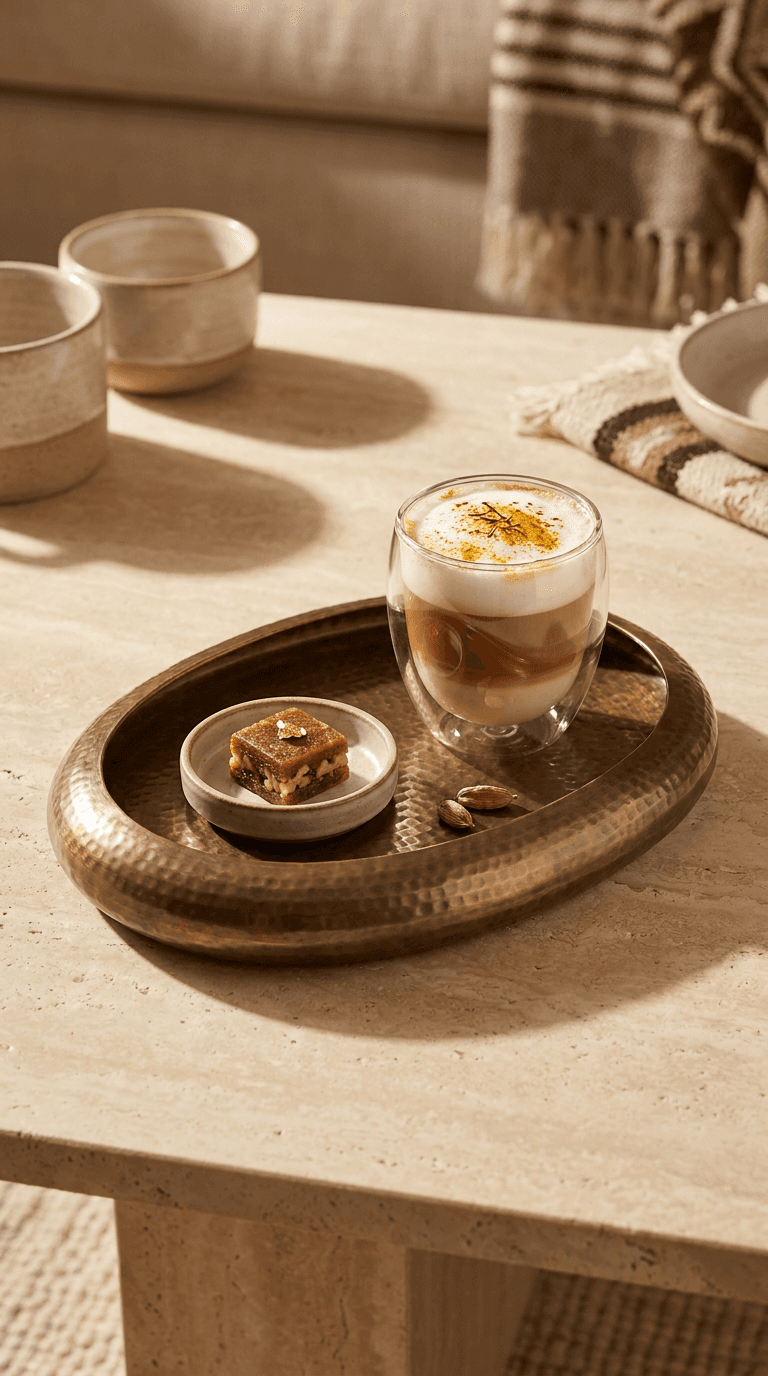
An exportable hospitality brand requires something recognisable after the postcode changes. That signature may be a beverage, dessert, pairing, vessel, scent, gifting format, service sequence, table gesture, spatial element or moment of generosity.
Whatever form it takes, it should pass four tests: distinctive enough to remember, repeatable enough to scale, protectable enough to matter and travelable enough to remain meaningful outside Qatar.
A signature product creates recognition. A signature ritual creates participation. A signature service behaviour creates emotional ownership. Together, they create brand IP.
Recognition then turns service into relationship. Contemporary luxury hospitality increasingly competes through emotional connection, personalisation, consistency and attention to detail. A Qatari-born brand can translate the cultural logic of receiving a guest into a modern service proposition defined by recognition, ease, discretion, anticipation, generosity and personal understanding.
CRM can make this scalable by remembering preferred seating, usual orders, dietary requirements, visit patterns, gifting history, important occasions and frequent companions. But the technology must remain backstage.

THE AUDIENCE
The strategy must accommodate different motivations without fragmenting the brand into different identities.
The Social Anchor uses hospitality to maintain relationships. Their rational need is ease; their emotional need is belonging. They value comfortable gathering, privacy when required, reliable service, coordination, familiarity and recognition. For them, luxury means being received properly.
The Cultural Seeker chooses places capable of revealing something meaningful about contemporary Doha. Their rational need is relevance; their emotional need is discovery. They value provenance, design intelligence, creative collaboration, cultural programming, local knowledge and experiences that could not simply exist anywhere. For them, luxury means access to a world worth understanding.
The Global Nomad moves comfortably between Doha, Riyadh, Dubai, London and other international centres. Their rational need is frictionlessness; their emotional need is recognition. They value consistency, access, speed, personalisation, social currency and familiar standards across markets. For them, luxury means being known wherever they arrive.
THE BRAND, MADE REAL
Strategy must become behaviour. Imagine a premium Qatari hospitality house built around the five principles — not a finished brand identity, but an operating prototype.
The experience begins before the transaction: dine-in guests receive a small seasonal expression of qahwa as an act of receiving rather than as a tourist demonstration. The space offers degrees of sociality — Retreat for quieter individual occupation, Exchange for meetings and informal work, and Gather for groups and longer social occasions. A proprietary beverage-and-bite pairing becomes the recognisable product code of the house, capable of seasonal evolution without losing its architecture.
Service operates through quiet recognition. Returning guests experience remembered preferences without unnecessary performance. Departure becomes as deliberate as arrival, perhaps through a small date, confection or seasonal object that is low in monetary value but high in mnemonic value.
Cultural activity is equally selective: fewer, better moments rather than a constant events calendar. One artist commission, one chef collaboration, one seasonal ritual, one intimate conversation or one limited publication can create more meaning than permanent content production.
FROM VENUE TO CULTURAL CAPITAL
A hospitality brand can gradually become more than a commercial venue. It can host meaningful gatherings, connect communities, patronise Qatari and regional creative talent, create platforms for chefs, artists and designers, and establish rituals to which people repeatedly return.
This opportunity is reinforced by a wider national shift. Qatar is increasingly treating food and hospitality as destination infrastructure. Taste of Qatar has introduced a national restaurant evaluation framework, the Michelin Guide has established Doha inside its international restaurant system, and the 2026 Qatar International Food Festival attracted 490,493 visitors over ten days.
PROOF THAT CULTURE CAN TRAVEL
Qatar does not need to prove from zero that culturally rooted hospitality can travel. Qinwan provides an existing proof point. Founded in 2017, the Qatari brand has built a premium proposition around Medjool dates, Arabic coffee, chocolate and gifting while framing the experience through the warmth and generosity of Arabian hospitality. Its international presence includes Dubai and London, with products available at Harrods.
The significance is not simply that a Qatari company opened abroad. It is what travelled: dates, coffee, gifting and Arabian hospitality. Cultural specificity did not prevent internationalisation. It became part of the reason to internationalise.
The wider GCC provides a second precedent. Dubai-developed concepts including Gaia, Kinoya and Somewhere have moved into major international markets while retaining recognizable menu, spatial or cultural codes.
SCALE WITHOUT LOSING MEANING
Before expansion, the brand should divide itself into three layers.
SACRED elements must not change: core hospitality philosophy, signature ritual, signature product architecture, service principles, proprietary codes and brand worldview.
TRANSLATABLE elements may evolve deliberately: menu composition, daypart emphasis, spatial configuration, cultural programming, communication and creative partnerships.
LOCAL elements should change: regulation, property constraints, labour structure, seasonality, sourcing, neighbourhood behaviour and operational requirements.
This avoids the two opposite failures of internationalisation: over-standardisation, where the brand travels intact but becomes culturally tone-deaf; and over-localisation, where it becomes appropriate everywhere and distinctive nowhere.
Internationalisation therefore requires consistency of meaning + intelligence of execution.
Market sequencing should also serve a strategic purpose. Doha proves the culture and unit economics. Riyadh tests regional transferability. Kuwait City offers selective GCC depth. Dubai creates regional visibility and a competitive stress-test. London tests global legibility and the value of provenance.
The first international test proposed here is Riyadh, where cultural proximity reduces the risk of unnecessary localisation while premium demand and market scale create a meaningful commercial test.
Growth must then remain selective. Every successful location creates pressure to open another, but every additional location also risks reducing scarcity, quality and meaning.
THE COMMERCIAL ENGINE
Culture is not the alternative to growth. It can be the source of it. The strategic framework creates a commercial chain.
RITUAL → RECALL
Repeated proprietary behaviours improve memory and recognition.
SIGNATURE → MARGIN + DISTINCTIVENESS
A hero product concentrates demand, supports premiumisation and gives customers something actively worth seeking.
RECOGNITION → FREQUENCY + LIFETIME VALUE
Personal understanding creates reasons to return that competitors cannot reproduce through promotion alone.
PLACE INTELLIGENCE → ASSET PRODUCTIVITY
Daypart and spatial strategy improve utilisation and broaden occasions of use.
CULTURAL CAPITAL → ORGANIC DESIRABILITY
Relevance can create conversation, earned attention, collaboration demand and social authority.
SCARCITY → PRICING POWER
Controlled distribution protects desirability.
PROVENANCE → EXPORT VALUE
Qatari origin becomes part of what the international customer is buying.
WHAT WOULD SUCCESS LOOK LIKE?
A cultural strategy still requires commercial measurement. The correct metrics should test whether the strategy is producing behaviour, not simply whether people like the branding.
Distinctiveness can be measured through unaided signature recall and recognition of proprietary service or product codes. Product power can be assessed through signature-product penetration, margin and repeat purchase. Relationship strength can be tracked through 30-, 60- and 90-day repeat visitation, known-guest share, returning-guest spend and use of recorded preferences.
Place productivity should examine revenue per occupied seat-hour, daypart revenue mix, dwell patterns and capacity utilisation. Direct customer equity can be measured through CRM identification, database quality and cross-location recognition. Cultural capital should be evaluated through earned media quality, organic search, creative collaboration demand, partnership quality and local-versus-visitor advocacy. Scale readiness requires service consistency, training time, unit economics and evidence that provenance remains legible after expansion.
THE BRAND SYSTEM
The brand ultimately operates across three interconnected levels:
NARRATIVE → EXPRESSION → ACTIVATION
Its positioning is a contemporary Qatari hospitality house that transforms the culture of receiving into a globally relevant social experience.
The narrative is built around three principles: Living Hospitality, where tradition appears through behaviour rather than nostalgia; Doha Rhythm, where the brand responds to the city’s patterns of time, movement and gathering; and Cultural Generosity, where hospitality provides more emotional value than the transaction requires.
Its expression should feel assured but never ostentatious, warm but never performative, culturally literate but never folkloric, contemporary but never generic, and discreet but never anonymous. The identity should resist obvious Gulf-luxury shorthand. Provenance does not require compulsory gold, generic desert palettes, decorative heritage theatre or a dallah on every surface. Origin can emerge through proportion, materiality, rhythm, typography, sound, service objects, spatial behaviour, ritual and proprietary symbols.
Activation translates the idea into design, service, product, culture, CRM and expansion. Space is shaped around Gulf social behaviour. Recognition becomes an operational standard. Products become ownable signatures rather than endless menu proliferation. Cultural participation remains selective. Data supports human memory invisibly. Expansion translates the system into new cities without dissolving it.
THE STRATEGIC SHIFT
The opportunity can ultimately be understood as a series of movements:
Hospitality as service → Hospitality as intellectual property
Imported prestige → Originated brand equity
Local aesthetic → Proprietary cultural codes
Heritage motif → Living ritual
Customer → Recognised guest
Loyalty programme → Belonging system
Beautiful venue → Cultural institution
More branches → Controlled distribution
Local relevance → Global provenance
Hosting international brands → Originating international brands
Qatar already possesses many of the conditions required to create globally significant hospitality brands: international connectivity, tourism growth, high-quality infrastructure, rising service standards, entrepreneurial ambition, a sophisticated F&B ecosystem and deep traditions of hospitality.
The risk is not that Qatar lacks hospitality. The risk is that its contemporary hospitality becomes so internationally fluent that it loses the behaviours capable of making it distinctive.
Once every global city can offer beautiful coffee, beautiful interiors, beautiful packaging and beautiful restaurants, beauty becomes infrastructure, not advantage.
The opportunity is therefore not to reproduce the majlis, package nostalgia or insert local ingredients into an otherwise interchangeable international concept. Something considerably more ambitious is possible: brands that translate the deeper structures of Qatari and Arabian hospitality — generosity, ritual, recognition, gathering, belonging and attention — into proprietary contemporary systems capable of travelling. Doha does not need to imitate London, Paris or Dubai in order to become internationally legible.
BUILD A MOMENT SO UNIQUE WITH DOHA THAT ANOTHER CITY WANTS IT.
Qatar's first age of global hospitality was focused on welcoming the world in. Its next step could be sending something unique into the world. And the next great Qatari hospitality export may not be a dish. It may not be coffee. It may not even be a restaurant.
IT MAY BE A WAY OF RECEIVING PEOPLE.
FROM HOST TO ORIGIN.


More work
REFERENCES
Invest Qatar, (2026), Sectors and opportunities: Food and beverage.
Michelin, (2025), ‘One new star shines in the MICHELIN Guide Doha’s second edition’.
National Planning Council, State of Qatar, (2024), Third National Development Strategy 2024–2030.
Qatar Tourism, (2025a), Taste of Qatar initiative.
Qatar Tourism, (2026), The culture of coffee in the Arab world.
Qinwan, (2026), About us / Boutiques.
The Peninsula Qatar, (2026), ‘Qinwan opens two additional branches at Dubai Mall and DXB’.